what is to be or not to be soliloquy about
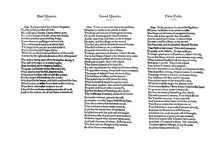
Comparison of the "To exist, or not to be" soliloquy in the start three editions of Hamlet, showing the varying quality of the text in the Bad Quarto, the Practiced Quarto and the First Folio
"To be, or not to exist" is the opening phrase of a soliloquy[a] given by Prince Hamlet in the and so-called "nunnery scene" of William Shakespeare's play Village, Act 3, Scene 1. In the speech, Hamlet contemplates decease and suicide, bemoaning the hurting and unfairness of life only acknowledging that the alternative might be worse. The opening line is one of the nearly widely known and quoted lines in modernistic English, and the soliloquy has been referenced in innumerable works of theatre, literature, and music.
Text [edit]
This version preserves nigh of the First Folio text with updated spelling and five common emendations introduced from the 2d ("Good") Quarto (italicised).[1]
To exist, or not to exist, that is the question:
Whether 'tis nobler in the mind to suffer
The slings and arrows of outrageous fortune,
Or to have Arms confronting a Body of water of troubles,
And by opposing end them: to dice, to sleep
No more; and by a sleep, to say we end
The heart-ache, and the thousand natural shocks
That Mankind is heir to? 'Tis a consummation
Devoutly to be wished. To dice, to sleep,
To slumber, perchance to Dream; aye, there's the rub,
For in that sleep of decease, what dreams may come,
When we have shuffled off this mortal coil,
Must give us pause. There's the respect
That makes Cataclysm of so long life:
For who would conduct the Whips and Scorns of time,
The Oppressor'due south incorrect, the proud man's Contumely,
The pangs of dispised Love, the Constabulary's delay,
The insolence of Function, and the spurns
That patient merit of th'unworthy takes,
When he himself might his Quietus make
With a bare Bodkin? Who would Fardels comport, [F: these Fardels]
To grunt and sweat under a weary life,
But that the dread of something after expiry,
The undiscovered land, from whose bourn
No traveller returns, puzzles the will,
And makes united states rather bear those ills we take,
Than wing to others that we know not of?
Thus conscience does make cowards of us all,
And thus the native hue of Resolution
Is sicklied o'er, with the pale cast of Idea,
And enterprises of great pitch and moment, [F: pith]
With this regard their Currents turn amiss, [F: away]
And lose the name of Action. Soft yous now,
The fair Ophelia? Nymph, in thy Orisons
Be all my sins think'd.
Get-go Quarto (1603) [edit]
The "Offset Quarto" (Q1) is the primeval edition of Village just is considered a bad quarto (essentially a theatrical knock-off) rather than a first or earlier draft, and although some parts of Q1 reflect the received text of Hamlet well, its version of "To be" does not. "Hope" in place of "dread", for example, considerably changes the pregnant. For ease of comparison the spelling here is updated as above.[two] [3]
To exist, or non to be, Ay there's the betoken,
To Die, to slumber, is that all? Yes all:
No, to sleep, to dream, aye marry there it goes,
For in that dream of death, when we awake,
And borne before an everlasting Estimate,
From whence no rider always returned,
The undiscovered country, at whose sight
The happy smiling, and the accursed damn'd.
But for this, the joyful hope of this,
Who'd bear the scorns and flattery of the globe,
Scorned past the right rich, the rich cursed of the poor?
The widow being oppressed, the orphan wrong'd,
The taste of hunger, or a tyrants reign,
And yard more calamities also,
To grunt and sweat under this weary life,
When that he may his full Quietus make,
With a bare bodkin, who would this suffer,
Just for a promise of something afterwards death?
Which puzzles the encephalon, and doth derange the sense,
Which makes us rather bear those evils nosotros have,
Than fly to others that we know not of.
Yep that, O this conscience makes cowards of us all,
Lady in thy orizons, be all my sins remembered.
Second Quarto (1604) [edit]
The text of the Second Quarto (Q2) is considered the primeval version of the play. In Q2 the whole nunnery scene including "To exist" takes place later in the play than in Q1 where it occurs directly after Claudius and Polonius have planned it[iv] and the addition of "Soft you now", suggesting that Hamlet has not (or is feigning having not) seen Ophelia thus far during his speech communication.[5]
To be, or not to be, that is the question,
Whether 'tis nobler in the heed to endure
The slings and arrows of outragious fortune,
Or to have Arms against a sea of troubles,
And by opposing, finish them, to die to sleep
No more, and by a sleep, to say nosotros cease
The heart-ache, and the thousand natural shocks
That flesh is heir too; tis a consumation
Devoutly to be wish'd to die to sleep,
To sleep, perhance to dream, ay, there's the rub,
For in that sleep of death what dreams may come up
When nosotros haue shuffled off this mortal coil
Muſt giue vs pauſe, there's the reſpect
That makes calamitie of ſo long life:
For who would beare the whips and ſcorns of fourth dimension,
Th'oppreſſors wrong, the proude mans contumly,
The pangs of deſpiz'd loue, the lawes delay,
The inſolence of office, and the ſpurnes
That patient merrit of the'vnworthy takes,
When he himſelfe might his quietas make
With a bare bodkin; who would fardels beare,
To grunt and ſweat vnder a wearie life,
Just that the dread of ſomething afterwards death,
The vndiſcouer'd country, from whose borne
No trauiler returnes, puzzels the will,
And makes vs rather beare thoſe ills we haue,
Then flie to others we know not of.
Thus conſcience dooes brand cowards,
And thus the natiue hiew of reſolution
Is ſickled ore with the pale caſt of thought,
And enterpriſes of great pitch and moment,
With this regard theyr currents turne awry,
And loose the proper name of action. Soft yous at present,
The faire Ophelia, Nimph in thy orizons
Be all my ſinnes remembred.
First Page (1623) [edit]
Mr. William Shakespeares Comedies, Histories, & Tragedies, published by Isaac Jaggard and Ed Blount in 1623 and ameliorate known as the "First Folio", includes an edition of Hamlet largely similar to the Second Quarto. The differences in "To be" are more often than not typographic, with increased punctuation and capitalization.[six]
To be, or non to be, that is the Question:
Whether 'tis Nobler in the mind to endure
The Slings and Arrows of outragious Fortune,
Or to take Armes confronting a Ocean of troubles,
And by opposing end them: to dye, to slumber
No more than; and by a sleep, to say we end
The Center-ake, and the thouſand Naturall ſhockes
That Flesh is heyre too? 'Tis a consummation
Deuoutly to be wiſh'd. To dye to sleepe,
To sleep, perhaps to Dream; I, there'southward the rub,
For in that sleep of death, what dreams may come,
When we haue ſhufflel'd off this mortall coile,
Muſt giue united states of america suspension. There's the respect
That makes Calamity of long life:
For who would beare the Whips and Scornes of time,
The Oppreſſors wrong, the poore mans Contumely,
The pangs of diſpriz'd Loue, the Lawes delay,
The inſolence of Office, and the Spurnes
That patient merit of the unworthy takes,
When he himſelfe might his Quietus brand
With a bare Bodkin? Who would theſe Fardles beare
To grunt and ſweat vnder a weary life,
Only that the dread of ſomething later decease,
The vndiſcouered Countrey, from whoſe Borne
No Traueller returnes, Puzels the will,
And makes vs rather beare those illes we haue,
Then flye to others that nosotros know non of.
Thus Conſcience does make Cowards of vs all,
And thus the Natiue hew of Resolution
Is ſicklied o're, with the pale caſt of Idea,
And enterprizes of great pith and moment,
With this regard their Currants turne away,
And looſe the proper noun of Action. Soft you now,
The faire Ophelia? Nimph, in thy Orizons
Be all my ſinnes remembred.
Cultural touch [edit]
"To be, or non to be" is one of the most widely known and quoted lines in modern English, and the soliloquy has been referenced in innumerable works of theatre, literature and music. Hamlet is unremarkably depicted equally reciting the first line while holding a skull, although both occur at separate times; the soliloquy is done in Deed Three, Scene I, while the contemplation of the skull is done in Act V, Scene I.[7]
Much of the plot of the 1942 sophisticated comedy To Be or Not to Be is focused on the monologue of Hamlet. In the 1957 comedy film A King in New York, Charlie Chaplin recites the famous monologue in the shoes of the cryptic King Shahdov.
Village's famous line inspired the title of Kurt Vonnegut's 1962 short story "2 B R 0 two B" (the zero is pronounced "zilch"). The narrative takes place in a dystopian future in which the United states government, through scientific advancement, has accomplished a "cure" for both aging and overpopulation. The alphabetical/numerical reformulation of Shakespeare's lines serves in the story as the phone number for the Federal Bureau of Termination's assisted suicide request line.[8]
In 1963 at a debate in Oxford, Black liberation leader Malcolm 10 quoted the first few lines of the soliloquy to make a point about "extremism in defense of freedom."[9]
P.D. James' dystopian novel The Children of Men (1992) refers to expected or forced mass suicides of the elderly as "Quietus". The motion-picture show adaptation Children of Men (2006) portrays a self-administered abode suicide kit, labelled "Quietus".
Concluding Action Hero (1993) has Jack Slater parody the phrase before blowing up a building behind him but by smoking a cigar. His version has him say "To be, or not to be? Not to be."
Star Trek 's sixth film (1991) was named afterwards the "Undiscovered State" line from this soliloquy, albeit the Klingon interpretation in which the title refers to the futurity and not death. References are made to Shakespeare during the moving-picture show including Klingon translations of his works and the use of the phrase "taH pagh, taHbe' ", roughly meaning "whether to keep, or not to proceed [existence]."
The 1978 novel by Richard Matheson and its 1998 picture show accommodation What Dreams May Come up derive their name from a line from this soliloquy.
A shorter Hindi version of "To be, or not to be" was recited by Shahid Kapoor in the 2014 Bollywood picture Haider.
Stargate Atlantis, the Season 4 Episode 10 named "This Mortal Coil" (2008) after the soliloquy, likewise as Season iv Episode xi named "Exist All My Sins Remember'd" (2008). These episodes involved learning about and fighting the artificial intelligence species Replicator.
There are numerous snowclones based on the phrase, such as "To hack or not to hack", etc.
The virtuoso soliloquy in Carl Michael Bellman's Fredman'due south Epistle "Ack du min moder" was described by the poet and literary historian Oscar Levertin as "the to-be-or-nothoped-for of Swedish literature".[10] [11]
Notes [edit]
- ^ Though it is called a soliloquy, Village is not alone when he makes this speech because Ophelia is on stage pretending to read while waiting for Hamlet to notice her, and Claudius and Polonius, who have placed Ophelia in Hamlet's way in order to eavesdrop their conversation and find out if Hamlet is actually mad or only pretending, have concealed themselves. Fifty-fifty so, Hamlet seems to consider himself alone and there is no indication that the others on phase hear him before he addresses Ophelia.
Further reading [edit]
- Bruster, Douglas. (2007). To exist or not to exist. London: Continuum. ISBN 9781441125002. OCLC 729252852.
- Dillane, Richard. "Making Sense of 'To exist or not to exist'", in Shakespeare and Montaigne edited by Lars Engle, Patrick Grayness, William Chiliad. Hamlin. Edinburgh University Press 2021. ISBN 9781474458238
References [edit]
- ^ Perseus Project. "Perseus:paradigm:1998.04.0773 Image:1998.04.0773". Tufts University. Accessed 24 Baronial 2013.
- ^ Shakespeare, William. The Tragicall Historie of Village Prince of Denmarke. As it hath beene diuerse times acted past his Highnesse seruants in the Cittie of London : as also in the two Vniuersities of Cambridge and Oxford, and else-where [The "Outset Quarto"], pp. 35 ff. Nicholas Ling & J. Trundell (London), 1603. Reprinted as The First Edition of the Tragedy of Hamlet: London, 1603. The Shakespeare Printing, 1825.
- ^ Shakespeare, William. [The "First Quarto"]. Hosted at The Shakespeare Quartos Annal equally Hamlet, 1603. Re-create i. Huntington Library, paradigm 17. Accessed 13 December 2013.
- ^ Tronch Pérez, Jesús. "Dramaturgy of the Acting Version of the First Quarto of Hamlet". SEDERI VII (1996), p. 219.
- ^ Shakespeare, William. The Tragicall Historie of Village, Prince of Denmarke. Newly imprinted and enlarged to most equally much againe as it was, co-ordinate to the truthful and perfect Coppie [The "2d Quarto"]. Nicholas Ling, 1604. Hosted at The Shakespeare Quartos Annal as Village, 1604. Copy 1. Folger Library, images 27 & 28. Accessed 13 December 2013.
- ^ Shakespeare, William. The Tragedie of Hamlet, Prince of Denmarke in Mr. William Shakespeares Comedies, Histories, & Tragedies Published co-ordinate to the Truthful Originall Copies [The "Commencement Folio"], p. 265. Isaac Jaggard & Ed Blount (London), 1623. Hosted at the Internet Shakespeare Editions as First Page, Page 773. Brandeis University. Accessed 13 Dec 2013.
- ^ Ghose, Indira (2010). "Jesting with Death: Hamlet in the Graveyard" (PDF). Textual Do. Routledge Publishing. 24 (6): 1003–18. doi:10.1080/0950236X.2010.521668. ISSN 0950-236X. S2CID 145808185 – via Taylor & Francis.
- ^ Vonnegut, Kurt. "2 B R 0 two B". gutenberg.org. The Projection Gutenberg. Retrieved 29 April 2017.
- ^ Colman, Dan (30 Baronial 2009). "Watch Malcolm Ten Contend at Oxford, Quoting Lines from Shakespeare's Village (1964)". Open Culture . Retrieved 3 December 2017.
- ^ Britten Austin, Paul. The Life and Songs of Carl Michael Bellman: Genius of the Swedish Rococo. Allhem, Malmö American-Scandinavian Foundation, New York, 1967. ISBN 978-three-932759-00-0 page 61
- ^ The original source is mentioned in Levertin, Oscar I. (1899). Introductory Essay to Fredmans Epistles (in Swedish).
External links [edit]
- Hamlet's To Exist Or Not To Be soliloquy translated into modern English
- The Fishko Files: The Many Faces of Hamlet from WNYC's Sara Fishko, a radio piece and accompanying blog post about the many interpretations of the soliloquy.
Source: https://en.wikipedia.org/wiki/To_be,_or_not_to_be
0 Response to "what is to be or not to be soliloquy about"
Post a Comment